
Find your pace, finish time or distance — instantly. Works in km and miles.
Enter distance and total time → get pace & speed.
Enter pace and distance → get finish time.
Enter pace and running time → get distance covered.
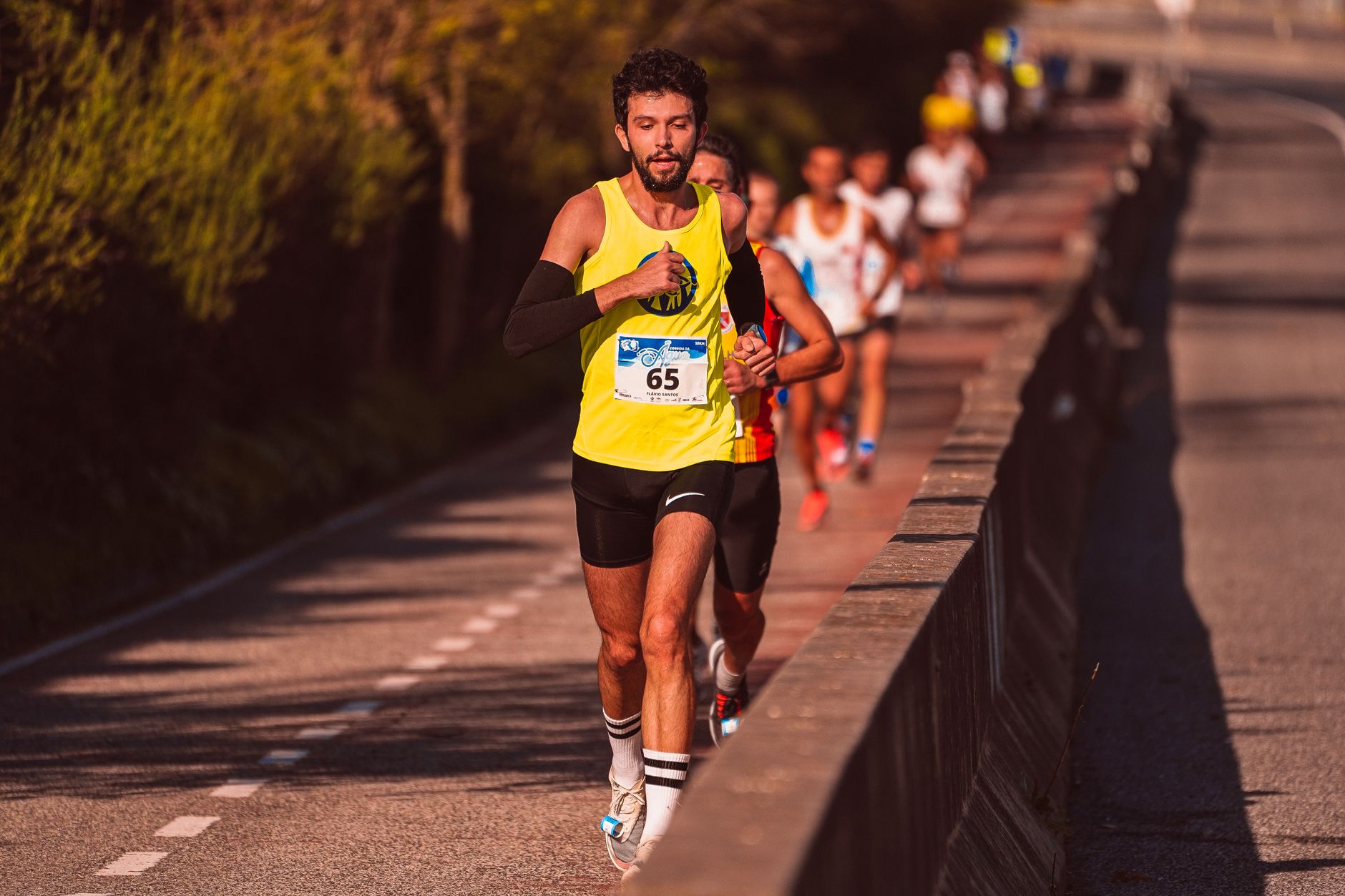
Running pace is the time it takes to cover one unit of distance — expressed as minutes per kilometre (min/km) or minutes per mile (min/mi). A pace of 5:00/km means you complete each kilometre in exactly five minutes. Pace is the inverse of speed: the faster you run, the lower (smaller) your pace number.
Speed (in km/h or mph) and pace are linked by a simple formula:
Speed (km/h) = 60 ÷ Pace (min/km)
e.g. 5:00/km → 60 ÷ 5 = 12 km/h
| Race | Distance | Beginner target | Intermediate | Advanced |
|---|---|---|---|---|
| 5 km | 5 km | 8:00–10:00/km | 5:30–7:00/km | <5:00/km |
| 10 km | 10 km | 7:30–9:30/km | 5:30–7:00/km | <4:30/km |
| Half marathon | 21.097 km | 7:00–9:00/km | 5:30–6:30/km | <4:45/km |
| Marathon | 42.195 km | 7:00–8:30/km | 5:41–6:30/km | <4:15/km |
Target paces are approximate. Training, terrain, and weather all affect actual performance.

There are three modes, each solving for one unknown:
Effective running training is structured around pace zones that correspond to different heart-rate intensities:
| Zone | Name | Feel | Purpose |
|---|---|---|---|
| Z1 | Easy / Recovery | Very easy — full sentences | Active recovery, long easy runs |
| Z2 | Aerobic base | Comfortable — can talk | Builds aerobic engine (80% of training) |
| Z3 | Tempo / Threshold | Comfortably hard — short phrases | Improves lactate threshold |
| Z4 | Interval | Hard — single words | VO2 max intervals, speed work |
| Z5 | Sprint | Maximum — cannot speak | Short all-out sprints, neuromuscular |
Most running coaches recommend the 80/20 rule: spend roughly 80% of training time in Z1–Z2, and only 20% in Z3–Z5. This builds a large aerobic base while avoiding overtraining.

| min/km | min/mile | km/h | mph |
|---|---|---|---|
| 4:00 | 6:26 | 15.00 | 9.32 |
| 4:30 | 7:14 | 13.33 | 8.29 |
| 5:00 | 8:03 | 12.00 | 7.46 |
| 5:30 | 8:51 | 10.91 | 6.78 |
| 6:00 | 9:39 | 10.00 | 6.21 |
| 6:30 | 10:28 | 9.23 | 5.74 |
| 7:00 | 11:16 | 8.57 | 5.32 |
| 8:00 | 12:52 | 7.50 | 4.66 |
| 9:00 | 14:29 | 6.67 | 4.14 |
| 10:00 | 16:05 | 6.00 | 3.73 |
Running pace is the time it takes to cover a unit of distance — typically expressed as minutes per kilometre (min/km) or minutes per mile (min/mi). A pace of 5:00/km means you run 1 km every 5 minutes.
Divide 60 by your pace in minutes per km. For example, a 5:00/km pace equals 60 ÷ 5 = 12 km/h. Our calculator does this conversion automatically.
A marathon is 42.195 km. To finish in under 4 hours you need a pace faster than 5:41 min/km (9:09 min/mile), approximately 10.55 km/h. Use the Finish Time tab with 4:00:00 and 42.195 km to verify.
Beginners typically run at 7–9 min/km (7–9.5 km/h). The key is to run at a conversational pace — you should be able to say a sentence without gasping. Speed improves naturally as your aerobic base builds.
Multiply your pace (in minutes) by the distance in km. For example, 5:30/km × 42.195 km = 232 minutes = 3 hours 52 minutes. Our calculator computes this instantly.