Solve for speed, distance or time instantly — supports km/h, mph, m/s and more.
What do you want to calculate?
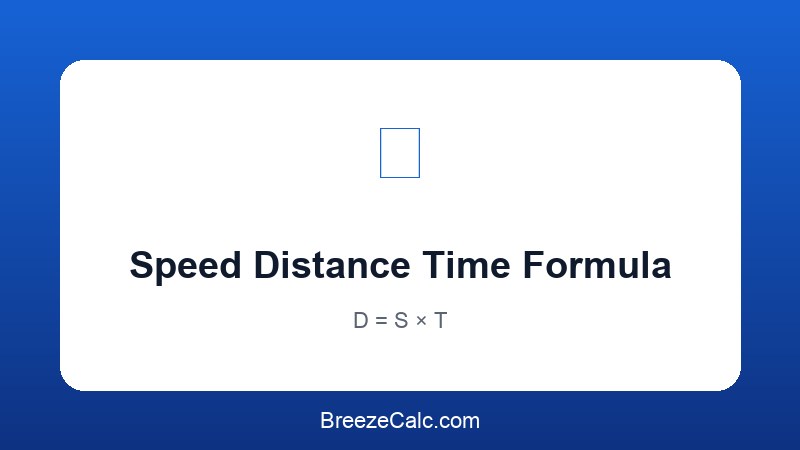
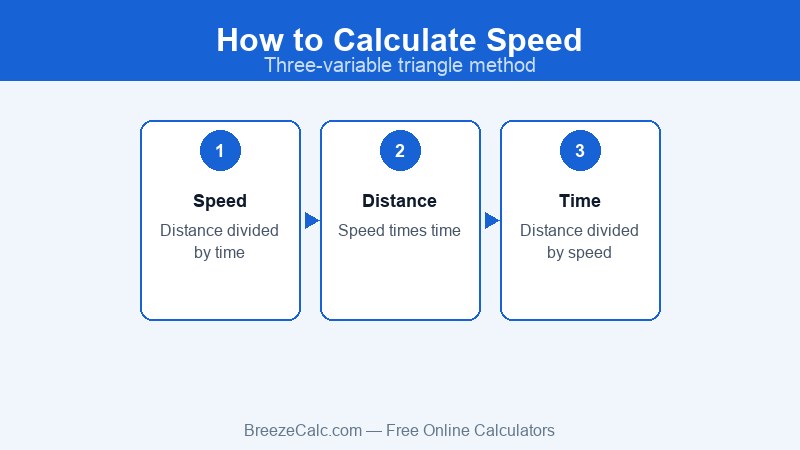
All three quantities are linked by a single triangle of equations:
Cover the value you want to find with your thumb, and the remaining two show you the operation. This is sometimes called the SDT triangle or DST triangle.
Example 1 — Road trip: You drive 240 km in 3 hours. Speed = 240 ÷ 3 = 80 km/h.
Example 2 — Cycling: You cycle at 25 km/h for 90 minutes (1.5 h). Distance = 25 × 1.5 = 37.5 km.
Example 3 — Running a 10K: You run 10 km at 12 km/h. Time = 10 ÷ 12 = 0.833 h = 50 minutes.
Example 4 — Marathon: A 42.195 km race at an average pace of 10 km/h. Time = 42.195 ÷ 10 = 4 h 13 min 10 s.
Example 5 — Flight: A plane travels 5,500 km at 850 km/h. Time = 5500 ÷ 850 ≈ 6 h 28 min.
| Mode of travel | Typical speed (km/h) | Typical speed (mph) |
|---|---|---|
| Walking (leisurely) | 4–5 | 2.5–3 |
| Brisk walking / hiking | 5–7 | 3–4.5 |
| Recreational cycling | 15–20 | 9–12 |
| Road cycling | 25–35 | 15–22 |
| City driving | 30–50 | 20–30 |
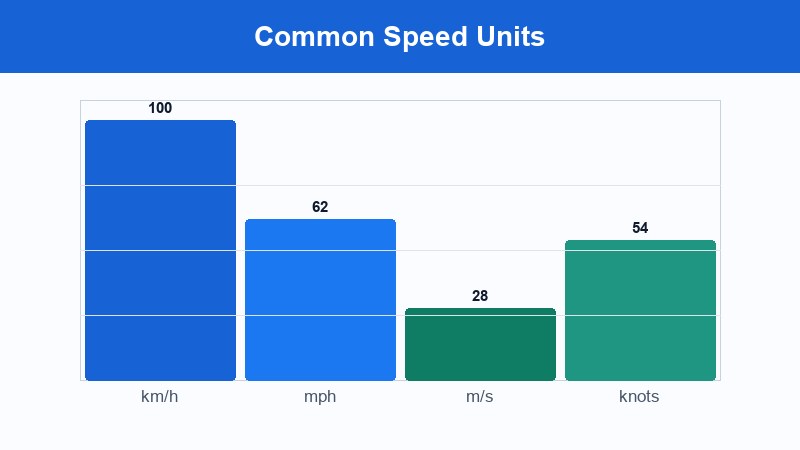
| Motorway / highway | 100–130 | 62–80 |
| High-speed train (TGV/AVE) | 200–350 | 125–217 |
| Commercial aircraft | 800–900 | 497–559 |
| Sound (at sea level, 20°C) | 1,235 | 767 |
| From | × factor | To |
|---|---|---|
| km/h | ÷ 1.60934 | mph |
| mph | × 1.60934 | km/h |
| km/h | ÷ 3.6 | m/s |
| m/s | × 3.6 | km/h |
| knots | × 1.852 | km/h |
| km/h | ÷ 1.852 | knots |
| mph | × 0.44704 | m/s |
| Unit | In meters | In km | In miles |
|---|---|---|---|
| 1 kilometer (km) | 1,000 | 1 | 0.6214 |
| 1 mile (mi) | 1,609.34 | 1.60934 | 1 |
| 1 nautical mile (nmi) | 1,852 | 1.852 | 1.1508 |
| 1 foot (ft) | 0.3048 | 0.0003048 | 0.000189 |
Runners often think in pace (min/km or min/mile) rather than speed. The relationship is: Pace (min/km) = 60 ÷ Speed (km/h).
| Speed (km/h) | Pace (min/km) | Pace (min/mi) | Race equivalent |
|---|---|---|---|
| 6 | 10:00 | 16:05 | Beginners / walk-run |
| 8 | 7:30 | 12:04 | Recreational runner |
| 10 | 6:00 | 9:39 | Good 10K pace |
| 12 | 5:00 | 8:03 | Sub-4h marathon |
| 14 | 4:17 | 6:54 | Club runner |
| 16 | 3:45 | 6:02 | Fast club runner |
| 20 | 3:00 | 4:50 | Elite marathon |
The three formulas form a triangle: Speed = Distance ÷ Time, Distance = Speed × Time, and Time = Distance ÷ Speed. Cover whichever value you are solving for, and the remaining two show the operation needed. All values must be in consistent units — e.g. if distance is in km and time is in hours, speed comes out in km/h.
Multiply by 0.6214, or divide by 1.60934. For example, 100 km/h ÷ 1.60934 ≈ 62.1 mph. The calculator does this automatically when you change the speed unit dropdown.
Divide by 3.6. For example, 72 km/h ÷ 3.6 = 20 m/s. To go the other way, multiply m/s by 3.6.
Time = Distance ÷ Speed = 100 ÷ 60 ≈ 1.667 hours = 1 hour 40 minutes. Enter 100 miles and 60 mph in the "Find Time" tab above to verify.
Average speed is total distance divided by total time for an entire journey. Instantaneous speed is how fast you are moving at one specific moment (what your speedometer shows). This calculator works with average speed — useful for journey planning, not for physics of acceleration.
1 knot = 1 nautical mile per hour = 1.852 km/h or 1.151 mph. Knots are the standard unit for maritime and aviation speeds. A typical cargo ship travels at 15–20 knots (28–37 km/h); a commercial jet cruises at about 480 knots (889 km/h).
Calculate the driving time using Time = Distance ÷ Speed, then add your stop durations separately. For example: 400 km at 100 km/h = 4 h driving + two 20-minute stops = 4 h 40 min total. This calculator gives you the pure travel time; add stops manually.
The speed of sound in air at 20°C (68°F) is approximately 1,235 km/h (767 mph or 343 m/s). The speed of light in a vacuum is exactly 299,792,458 m/s (about 1,079 million km/h). Aircraft that exceed the speed of sound are said to be "supersonic" (Mach 1+).
The calculator uses standard conversion factors (1 mile = 1.60934 km, 1 knot = 1.852 km/h) and standard floating-point arithmetic. Results are accurate to the precision of your inputs. For navigation or safety-critical applications, always verify with authoritative tools.
When planning a road trip, divide the total distance by your expected average speed (accounting for traffic, not just the speed limit). A 300 km journey at an average of 80 km/h (factoring in towns and junctions) takes 3 h 45 min, not the 2 h 30 min you'd calculate at 120 km/h motorway speed.
Runners use pace (min/km or min/mi) as the inverse of speed. A 5:00 min/km pace = 12 km/h. To convert pace to speed: Speed (km/h) = 60 ÷ Pace (min/km). Use the "Find Time" mode to predict your race finish time based on your target pace.
Average cycling speeds vary widely: 15–20 km/h for leisure, 25–35 km/h for road cyclists. Headwind can reduce effective speed by 20–30%, so always add a buffer when estimating journey time.
Flight times are calculated using ground speed (airspeed adjusted for wind). A headwind of 50 knots on a 1,000 nm route at 450 knots airspeed gives a ground speed of 400 knots — adding about 21 minutes compared to still air.
The SDT triangle is one of the first physics formulas students learn. Always check that your units are consistent before calculating. Mixing km/h with minutes (instead of hours) is the most common source of errors — always convert time to hours when using km/h.