
Unit Converter
Instantly convert length, weight, temperature and area — metric, imperial and scientific units, results as you type.
Converter
What is a unit converter?
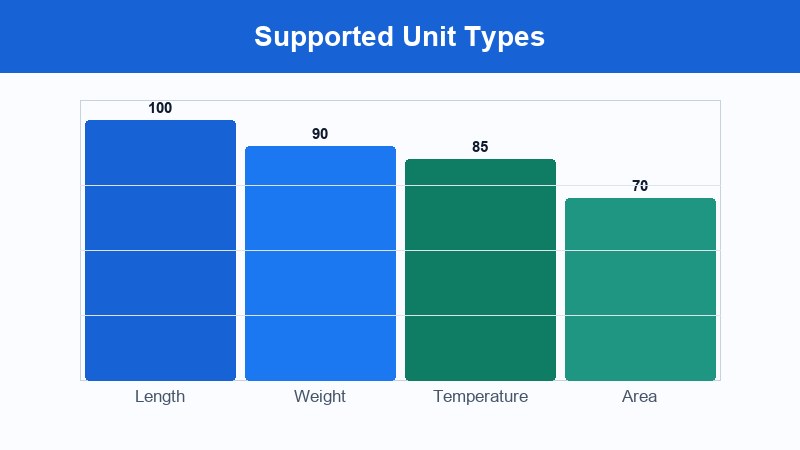
A unit converter expresses a measurement in one system — metric, imperial, or scientific — as its equivalent in another. Instead of memorising conversion factors or doing manual arithmetic, you type a value and the result appears instantly. This converter covers four categories used every day: length, weight (mass), temperature, and area. Every conversion runs locally in your browser — nothing is sent to a server.
Whether you are following a recipe that lists ingredients in ounces when you only have a kitchen scale in grams, planning a road trip between countries that use different distance units, or converting a land measurement from acres to hectares for a property document, a reliable unit converter saves time and prevents costly errors.
How to use each tab
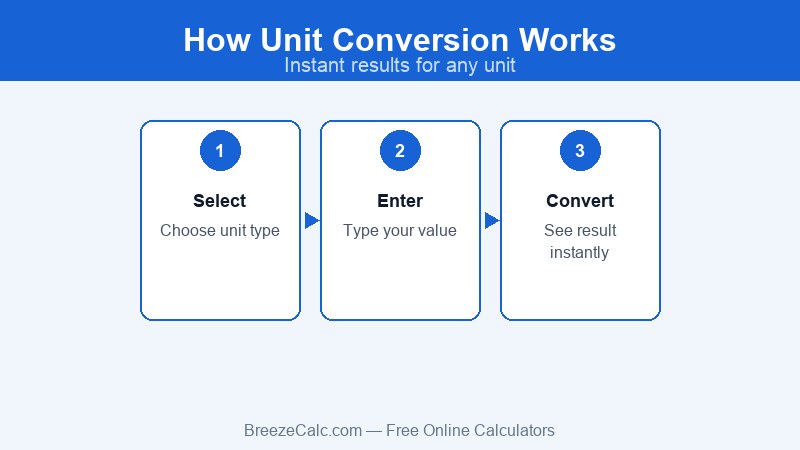
All four tabs share the same layout. Enter a number in the left field, choose source and target units from the two drop-downs, and the result updates in real time — no button needed. The swap button (⇄) reverses the conversion without retyping.
Length tab
The length tab covers eight units spanning the full range from millimetres (used in engineering and machining) to miles (road distances in the US and UK). All values convert internally through metres. To convert 5 ft 9 in, first convert the inches fraction to feet: 9 ÷ 12 = 0.75, then enter 5.75 in the value field with Feet selected as the source unit.
Weight tab
The weight tab uses kilograms as the pivot unit. It covers milligrams (medication dosing, nutrition labels) through metric tonnes (shipping, construction). The ounce used here is the avoirdupois ounce (28.3495 g), the standard for food and everyday goods — not the troy ounce used for precious metals.
Temperature tab
Temperature conversions need offset formulas because Celsius, Fahrenheit and Kelvin do not share a common zero point. The calculator applies the correct formula automatically. Kelvin is used in physics and chemistry; absolute zero (0 K) is the coldest possible temperature, equivalent to −273.15 °C or −459.67 °F.
Area tab
Area units scale as the square of length units. One square kilometre equals one million square metres, not one thousand. This tab covers everyday units from square centimetres (small surfaces) to hectares (farmland, national parks), with acres and square feet for countries using the imperial system.
Length conversion factors
| Unit | Symbol | Metres (exact) | Feet |
|---|---|---|---|
| Millimetre | mm | 0.001 | 0.003281 |
| Centimetre | cm | 0.01 | 0.032808 |
| Metre | m | 1 | 3.28084 |
| Kilometre | km | 1,000 | 3,280.84 |
| Inch | in | 0.0254 | 0.083333 |
| Foot | ft | 0.3048 | 1 |
| Yard | yd | 0.9144 | 3 |
| Mile | mi | 1,609.344 | 5,280 |
Weight conversion factors
| Unit | Symbol | Kilograms (exact) | Pounds |
|---|---|---|---|
| Milligram | mg | 0.000001 | 0.0000022 |
| Gram | g | 0.001 | 0.0022046 |
| Kilogram | kg | 1 | 2.20462 |
| Metric tonne | t | 1,000 | 2,204.62 |
| Ounce | oz | 0.0283495 | 0.0625 |
| Pound | lb | 0.453592 | 1 |
Temperature formulas
| Conversion | Formula | Example |
|---|---|---|
| °C to °F | (°C × 9/5) + 32 | 37 °C = 98.6 °F |
| °F to °C | (°F − 32) × 5/9 | 72 °F = 22.2 °C |
| °C to K | °C + 273.15 | 0 °C = 273.15 K |
| K to °C | K − 273.15 | 300 K = 26.85 °C |
| °F to K | (°F − 32) × 5/9 + 273.15 | 32 °F = 273.15 K |
| K to °F | (K − 273.15) × 9/5 + 32 | 373.15 K = 212 °F |
Area conversion factors
| Unit | Symbol | Square metres (m²) | Hectares |
|---|---|---|---|
| Square centimetre | cm² | 0.0001 | 0.00000001 |
| Square metre | m² | 1 | 0.0001 |
| Square kilometre | km² | 1,000,000 | 100 |
| Square inch | in² | 0.00064516 | 0.000000064516 |
| Square foot | ft² | 0.092903 | 0.0000092903 |
| Acre | ac | 4,046.856 | 0.404686 |
| Hectare | ha | 10,000 | 1 |
Practical conversion examples
Frequently asked questions
How accurate are these conversions?
All conversion factors are exact defined values for length, weight and area. Temperature formulas are mathematically exact. Results display to 6 significant figures, which exceeds the precision of any household measuring instrument. For scientific applications needing higher precision, use a dedicated arbitrary-precision calculator.
What is the difference between mass and weight?
Mass is the amount of matter in an object, measured in kilograms. Weight is the gravitational force on that mass, measured in Newtons. On Earth's surface they are proportional — 1 kg weighs about 9.81 N. In everyday speech "weight" is used to mean mass, which is why scales show kilograms or pounds rather than Newtons.
Why does temperature need formulas rather than multiplication?
Because Celsius and Fahrenheit do not share the same zero point. Zero Celsius is 32 Fahrenheit, not 0. Kelvin shares absolute zero with thermodynamics, so Celsius ↔ Kelvin only needs an offset of 273.15. Fahrenheit also has a different scale factor (9/5), making its formula slightly more complex.
How many square metres are in an acre?
Exactly 4,046.8564224 square metres. One international acre is defined as 4840 square yards, and one international yard is exactly 0.9144 metres, so the result is exact.
What is the difference between a metric tonne and a US short ton?
A metric tonne is exactly 1000 kg. A US short ton is 2000 lb (about 907.185 kg). A UK long ton is 2240 lb (about 1016.05 kg). This converter uses the metric tonne. Check context when a document says "ton" without qualification — US sources typically mean the short ton.
Can I convert feet and inches together?
Convert the inches to a decimal first: divide inches by 12 (e.g. 9 in = 0.75 ft), add to the feet value (5 ft 9 in = 5.75 ft), then convert 5.75 ft to your target unit using the Length tab.
Is a hectare the same as a square kilometre?
No. One square kilometre equals 100 hectares. A hectare is 10,000 m² (a 100 m × 100 m square), while a square kilometre is 1,000,000 m² (1000 m × 1000 m).
Which ounce does this converter use?
The avoirdupois ounce (28.3495 g), used for food and everyday goods. The troy ounce (31.1035 g) is used exclusively for precious metals and is not included here.